
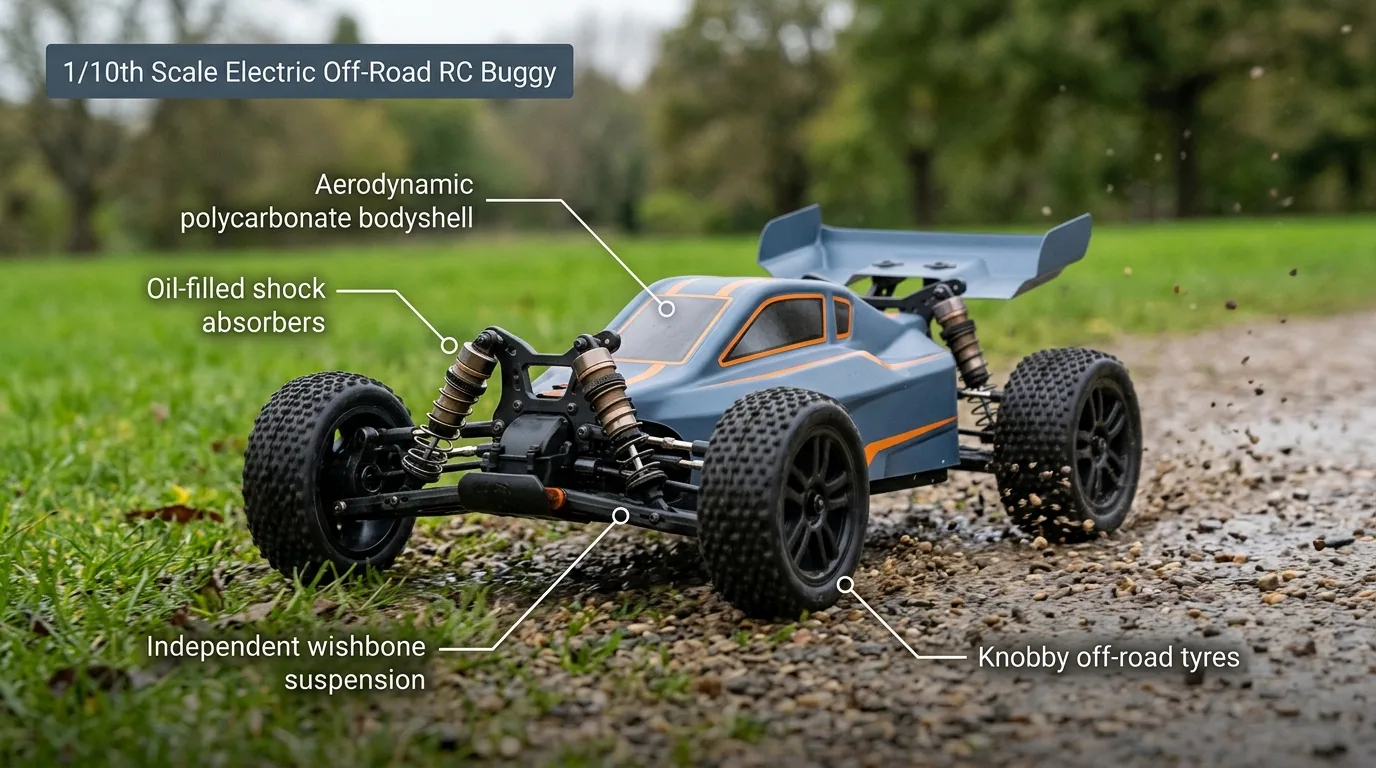
Selecting a hobby-grade radio-controlled (RC) car or truck in the UK comes down to matching the vehicle type, scale, and powertrain to the ground you plan to drive on. Prioritising modular electrics, active UK spares support, and club class alignment helps ensure your chassis stays repairable and enjoyable long after the first run.
How Hobby-Grade RC Cars and Trucks Differ From Toy-Grade Models
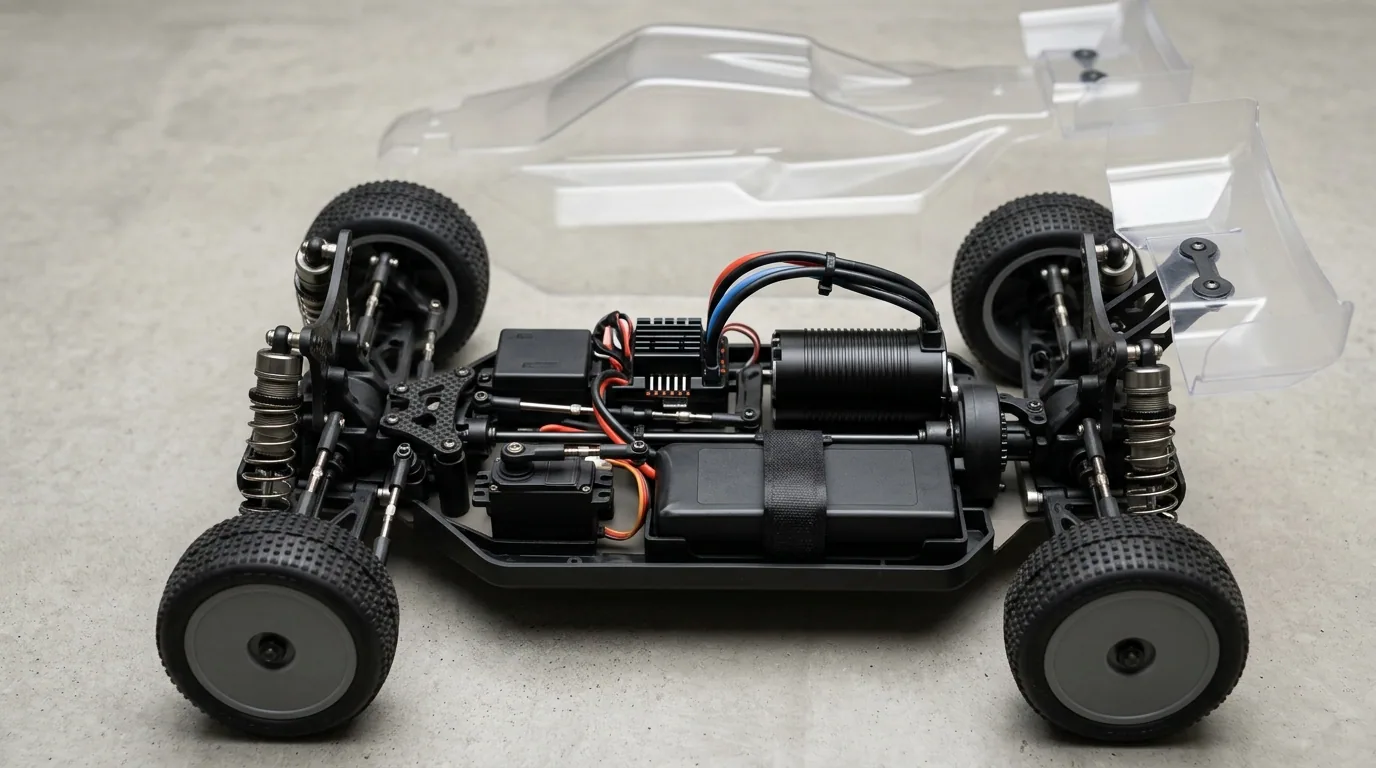
The defining difference between a hobby-grade RC vehicle and a disposable toy-grade car lies in how the chassis is built and supported after a crash or routine wear. Toy-grade models typically rely on sealed, single-board electronics and proprietary plastic assemblies that are difficult or impossible to service once a gear strips or a receiver fails. By contrast, hobby-grade RC platforms use modular, replaceable electrics—separating the motor, speed controller, steering servo, and radio gear into distinct components. If one part fails or you decide to adjust performance later, you can swap that single component without discarding the rest of the vehicle.
Long-term repairability also depends on dedicated parts ecosystems. Established UK hobby brands maintain extensive model-specific spares catalogues alongside general and model-specific option parts, often referred to as hop-ups. In the FTX RC range, for example, individual spares and hop-up lines are stocked across specific electric, nitro, and crawler platforms—covering everything from wheels, tyres, and bodyshells to drivetrain components. Pairing a supported chassis with a consistent spares and routine maintenance habit turns inevitable kerb impacts or worn bearings into straightforward workbench repairs rather than the end of the car.
Standardised sizing is the third hallmark of hobby-grade ownership. Rather than arbitrary novelty dimensions, hobby vehicles follow established scales such as 1/10th, 1/16th, and 1/18th. This standardisation makes it easier to source compatible wheels, tyres, and bodyshells across brands, and it connects casual driving to organised UK motorsport. Common categories such as 1/10th off-road and 1/12th on-road align directly with structured club and national championship calendars overseen by the British Radio Car Association (BRCA).
Matching RC Vehicle Types and Scales to UK Terrain
AI-generated generic editorial illustration — not a retailer product photo and does not depict the reviewed product or service. Editorial illustration supporting this section.
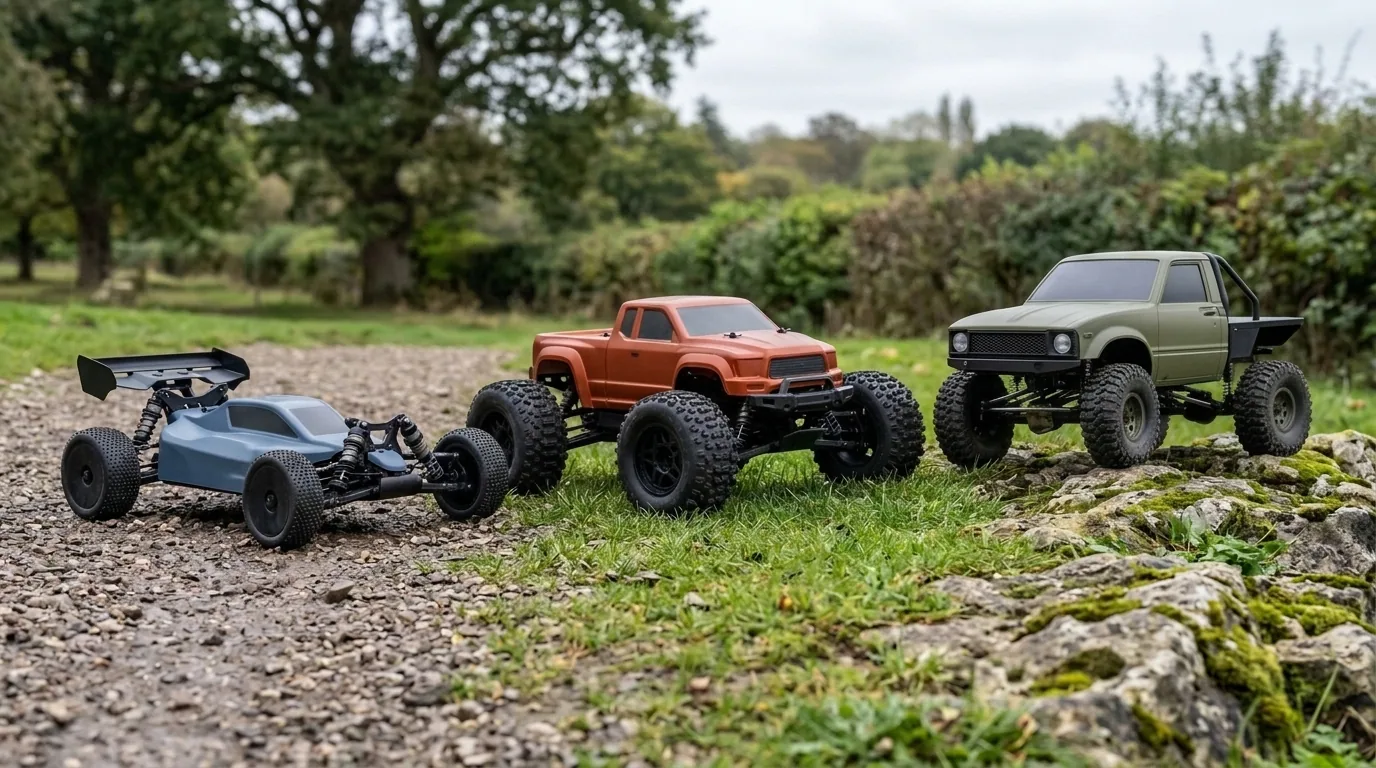
Before comparing powertrains or specifications, start with where you will actually drive. UK running spots vary widely—from damp park grass and compacted gravel paths to compact back gardens, rocky woodland trails, and indoor carpet tracks—and each surface rewards a different chassis layout and scale.
Across the UK hobby market, 1/10th scale serves as the primary all-round standard. Catalogue support for 1/10th off-road wheels and tyres, 1/10th scale bodies, and 1/10th crawler bodies is broad, giving owners plenty of choice when replacing damaged shells or tuning grip for wet turf and loose dirt. A 1/10th footprint offers enough ground clearance and wheel diameter to handle typical British park grass and uneven gravel without feeling unwieldy to transport, and it is also the scale used in BRCA 1/10th off-road national and club racing.
Where space is limited, smaller 1/16th and 1/18th off-road vehicles and mini crawlers provide a more practical alternative. Dedicated 1/18th off-road wheel and tyre sets and 1/16th scale bodyshells reflect strong UK support for compact platforms. These smaller rigs fit tighter suburban gardens, indoor garages, and portable rucksack trail runs where full 1/10th clearance is unnecessary and high top speeds would quickly run out of room.
Within those scales, vehicle type shapes how the car behaves on terrain:
- Off-road buggies: Low-slung and agile, buggies handle compacted gravel, dirt paths, and club off-road tracks cleanly, though shorter tyres can struggle in uncut grass.
- Off-road and monster trucks: Wider stances, taller tyres, and generous suspension travel give trucks the ground clearance needed for rougher park grass, bumps, and open bashing.
- Scale rock crawlers: Built for technical woodland paths, tree roots, and mossy stone, crawlers prioritise low-speed torque, suspension articulation, and detailed scale bodyshells and accessories over outright speed.
- On-road cars: Suited to smooth tarmac car parks or dedicated club circuits, including BRCA 1/12th national indoor categories, where low ride height improves cornering stability.
Strengths of Modern Electric and Brushless RC Platforms
AI-generated generic editorial illustration — not a retailer product photo and does not depict the reviewed product or service. Editorial illustration supporting this section.
For most UK first-time buyers, casual park bashers, and club regulars, electric RC platforms provide a straightforward path into the hobby. The immediate practical advantage is lower-noise operation. Many UK public parks, recreation grounds, and residential cul-de-sacs have noise sensitivities or local restrictions where the sharp exhaust note of a nitro engine can draw complaints and limit where you can run. An electric car or truck runs quietly enough to use across a far wider range of everyday outdoor spaces without disturbing nearby residents or park visitors.
Day-to-day convenience is equally compelling. Rather than mixing fuel, warming glow plugs, or adjusting carburettor needles for damp British weather, an electric platform is ready to run as soon as a charged battery pack is connected. Once you adopt a sensible LiPo battery and charger safety routine—using appropriate storage charging and fire-resistant charging bags—electric power delivers consistent throttle response across cold winter mornings and warm summer evenings alike.
Because hobby-grade electric chassis separate their electrics into discrete motors, speed controllers, steering servos, and radio gear, they also offer a clear upgrade path. A newcomer can begin with a forgiving, controllable setup to build steering and throttle confidence, then step up to a higher-output brushless motor, a more capable electronic speed controller, or a faster metal-geared servo as their skills progress.
Finally, electric power spans virtually every vehicle category in UK hobby catalogues, from entry-level 1/10th buggies and bashing trucks to 1/18th minis and scale rock crawlers. That broad platform availability makes it much easier to standardise on a single battery connector and charger ecosystem as your collection grows, reducing duplicate equipment costs when you add a second vehicle for a different type of terrain.
Key Limitations Across RC Powertrains and Build Formats
Every RC powertrain and build format carries trade-offs, and recognising those limitations upfront helps prevent frustration and unexpected running costs.
Although nitro RC cars remain part of established UK hobby ranges—with dedicated nitro models and model-specific nitro spares available—they demand significantly more hands-on upkeep than electric equivalents. Running nitro requires purchasing specialised fuel, managing engine tuning as air temperature and humidity shift, and carrying out regular cleaning and mechanical maintenance after sessions. Combined with higher exhaust noise, nitro is generally less convenient for spontaneous UK park running unless you specifically enjoy internal-combustion mechanics and have an appropriate open venue.
Build format is another common source of surprise for newer buyers. Self-build RC kits are popular with hobbyists who want thorough build familiarity and full freedom over component selection. However, a kit rarely represents the total cost of getting onto the ground. Buyers typically need to budget separately for a motor, speed controller, steering servo, radio gear, batteries, charger, and paint or tools to finish a clear bodyshell.
Even within electric ready-to-run platforms, stepping straight into high-speed brushless setups comes with mechanical consequences. Higher acceleration and top speed place greater load on differentials, driveshafts, and spur gears, while crashes at speed multiply impact forces on suspension arms and shock towers. Regular bashers running brisk brushless power should expect faster drivetrain wear and treat readily available UK spares and durability hop-ups as a core requirement rather than an afterthought.
Lastly, buyers hoping to progress into organised competition should check club rules before using entry-level bashing trucks and casual off-roaders for structured racing. BRCA-sanctioned club and national categories enforce specific class regulations on chassis layout, scale, and electrics, meaning a recreational basher may eventually need to be replaced with a class-compliant platform.
Evaluating UK Spares Availability and Club Racing Compatibility
AI-generated generic editorial illustration — not a retailer product photo and does not depict the reviewed product or service. Editorial illustration supporting this section.
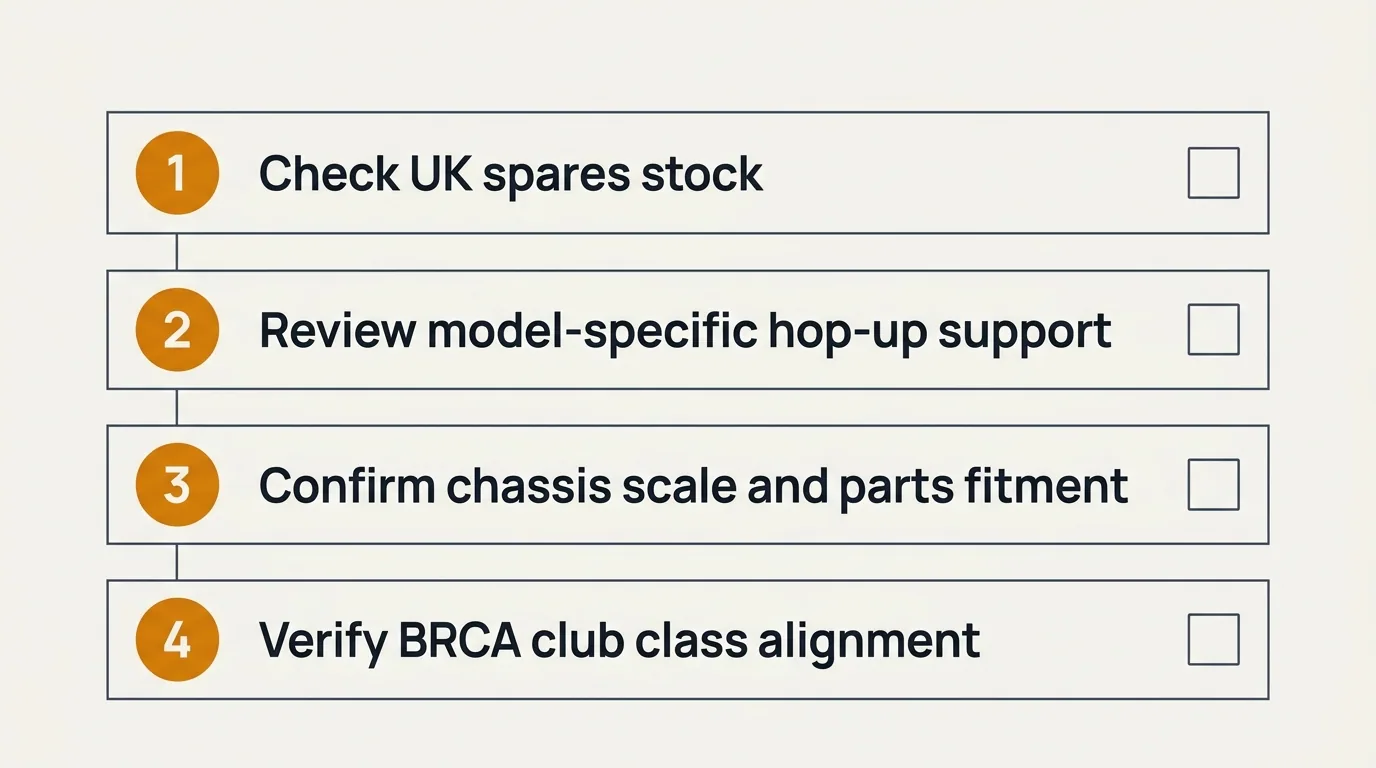
A well-specified chassis quickly loses its appeal if a broken suspension arm or stripped spur gear leaves it sitting on a shelf for weeks. Before committing to any brand or model, run through four practical UK ownership checks:
- Check active UK spares stock: Confirm that the exact model has a live UK spares catalogue covering wear items and crash-prone parts—including drivetrain components, suspension hardware, wheels, tyres, and replacement bodyshells. Brands with structured model-by-model spares lists, such as FTX's individual spares ranges across its buggies, trucks, and Outback crawlers, make it straightforward to identify and order the right replacement part and minimise downtime.
- Review model-specific hop-up support: Look for both general option parts and dedicated hop-up lines tailored to that specific chassis. Access to targeted upgrades lets you reinforce high-stress areas or refine handling as your driving gets more ambitious, extending the useful life of the platform instead of forcing a full vehicle replacement.
- Confirm chassis scale and parts fitment: Verify whether the vehicle uses widely supported UK scale standards—such as 1/10th off-road, 1/18th off-road, or 1/10th and 1/16th bodyshell formats—so you are not locked into scarce proprietary tyres or shells.
- Verify BRCA club class alignment: If organised racing is part of your plan, check before you buy. The BRCA oversees structured UK racing across categories such as 1/10th off-road nationals, EOS events, LMP nationals, and 1/12th national championships. Reviewing current BRCA calendars alongside your nearest local club's class rules ensures the chassis, scale, and electrics you choose will be eligible on race night rather than restricted to open practice sessions.
Taking ten minutes to verify parts catalogues and local club classes upfront protects your budget and keeps your vehicle running consistently throughout the season.
Shortlisting the Right RC Platform for Your Budget and Use Case
No single RC car or truck suits every driver, surface, and budget. Narrowing your shortlist works far more reliably when you match your primary use case to the right combination of vehicle type, scale, powertrain, and parts ecosystem.
First-time UK buyers and park bashers generally get the smoothest start with a 1/10th or 1/16th electric ready-to-run (RTR) buggy or off-road truck backed by clear UK spares support. Choosing a 1/10th truck gives extra ground clearance for damp park grass and rougher ground, while a 1/16th or 1/18th electric platform suits smaller gardens and easy transport. Keep part of your starter budget aside for essential accessories—such as a reliable charger, spare battery pack, and basic hex tools—rather than spending everything on the chassis alone.
Scale trail enthusiasts who care more about realism, obstacle navigation, and relaxed woodland walks than outright speed fit naturally into 1/10th or mini rock crawler lines. Look for platforms supported by dedicated crawler wheels and tyres, 1/10th or mini crawler bodyshells, and scale accessories so you can personalise appearance and grip for wet roots and stone.
Aspiring club racers should invert the usual buying sequence. Visit or contact your nearest UK club first to confirm which BRCA-aligned classes—such as 1/10th off-road or 1/12th on-road—actually run regularly on their track surface. Once you know the active class rules, select a compliant chassis and invest in track-appropriate tyres and modular electrics that match those regulations.
Hands-on builders who enjoy assembly and customisation can consider an RC kit, provided the budget accounts for purchasing the motor, speed controller, servo, radio gear, and bodyshell finishing separately.
Whichever profile matches your driving, anchor your final choice on three non-negotiables: a scale that fits your local terrain, modular serviceable electrics, and verifiable UK spares availability.
Frequently Asked Questions
Is a 1/10th or 1/18th scale RC car more practical for UK parks and gardens?
A 1/10th scale off-road car or truck is generally more practical for UK public parks, gravel paths, and short grass because its larger wheels and higher ground clearance handle uneven turf more effectively, and it benefits from broad UK wheel, tyre, and bodyshell support. By contrast, a 1/18th or 1/16th platform is often a better fit for compact back gardens, indoor spaces, or portable trail sessions where full 1/10th size would feel cramped.
Should a first-time UK buyer choose an electric or nitro RC car?
Most first-time UK buyers are better served by an electric RC platform. Electric cars and trucks run far more quietly in UK parks and residential areas, require no fuel mixing or carburettor tuning, and use modular motors, speed controllers, and servos that can be upgraded as your driving improves. Nitro platforms suit hobbyists who specifically want engine tuning and mechanical maintenance and have access to a noise-tolerant running area.
How important is UK spares availability when choosing an RC brand?
UK spares availability is a major factor in hobby-grade ownership. Even well-built RC vehicles experience broken suspension arms, worn tyres, or stripped gears during regular off-road driving. Choosing a brand with an active UK catalogue of model-specific spares and hop-up option parts keeps repairs quick and affordable, preventing minor crashes from sidelining your car for weeks.
Can I race a standard hobby-grade bashing truck at a BRCA club?
Not automatically. While some local clubs run informal novice or open heats, structured BRCA club and national racing—such as 1/10th off-road or 1/12th on-road championships—operates under specific class rules covering vehicle type, scale, and electrics. Check your local club's active BRCA-aligned classes before buying if organised racing is a priority.
Sources
Related reading
- How RC Cars and Trucks should fit, feel, and perform
- When to buy RC Cars and Trucks for better value
- How to identify genuine RC Cars and Trucks deals
- Best RC Cars and Trucks: evidence-led top choices
Editorial information: About our editorial team · Read our editorial policy · Read our affiliate disclosure.