
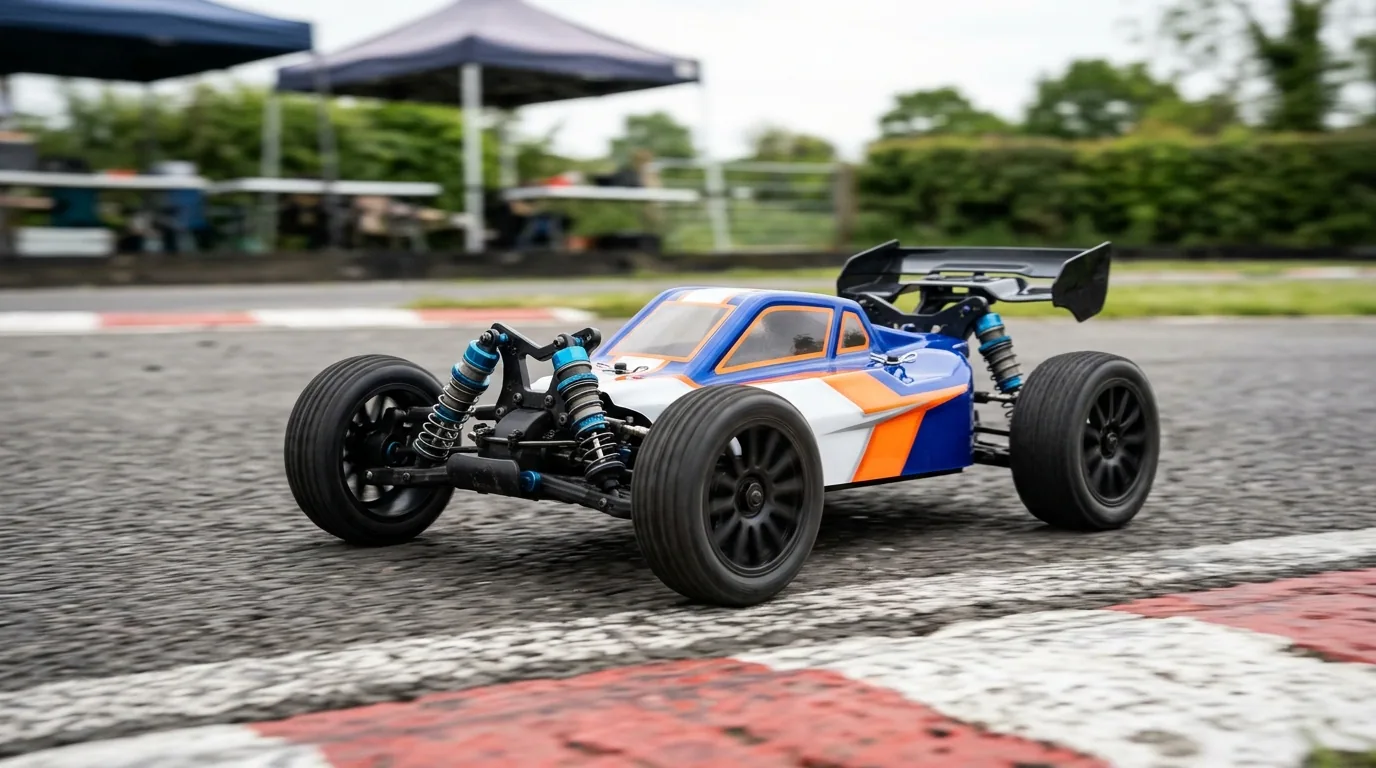
Tamiya maintains one of the most comprehensive catalogues in radio-controlled modelling, pairing a wide range of vehicle categories with its own spare parts, equipment, tools, and finishing supplies. For UK hobbyists deciding between a build-oriented platform and a ready-to-run brushless alternative, this practical assessment examines what Tamiya officially offers, where its ecosystem excels, and which details require retailer-level checks before you buy.
Tamiya RC Overview and Catalogue Scope
Tamiya's official R/C Models index sets out a broad, multi-category architecture rather than focusing on a single style of vehicle. On its published RC top page, Tamiya organises its core vehicle lineup into five distinct pillars: Electric R/C Cars, Glow-Engine R/C Cars, R/C Tractor Trucks, R/C Tanks, and the TRF Series. For UK newcomers comparing kit-based ownership with ready-to-run packages, that structure is an important starting point—it signals a manufacturer that serves casual electric drivers, internal-combustion enthusiasts, heavy-scale model builders, and track-focused racers under one roof.
Equally notable is how Tamiya surrounds those vehicles with first-party support categories. Directly within the R/C Models section, the company lists dedicated R/C Parts and R/C Equipment ranges to cover ongoing maintenance and running gear. Beyond the RC tab itself, Tamiya's Tools & Paints catalogue provides Finishing Materials, Tamiya Craft Tools, Paints, the Tamiya Airbrush System, and Display Goods, sitting alongside its extensive Static Models and Mini 4WD divisions. Together, these categories form a cohesive hobby ecosystem aimed at owners who enjoy building, painting, and maintaining their models as much as driving them.
That build-first identity remains visible across wider RC hobbyist media. Even on basher-focused editorial sites such as Big Squid RC—whose coverage frequently spotlights modern ready-to-run releases and high-power brushless machines—Tamiya continues to draw attention for creative, project-driven builds, including featured video coverage of a life-size Tamiya Volkswagen Dune Beetle Cross racing project. For UK buyers, understanding this positioning helps clarify what Tamiya does best before weighing individual chassis options at a local hobby shop.
Core Strengths of Tamiya RC Platforms
AI-generated generic editorial illustration — not a retailer product photo and does not depict the reviewed product or service. Editorial illustration supporting this section.
The most verifiable strength of Tamiya's RC programme is the breadth of vehicle disciplines available from a single manufacturer. A hobbyist starting with Electric R/C Cars can stay within the same brand ecosystem if they later branch into Glow-Engine R/C Cars, detailed R/C Tractor Trucks, R/C Tanks, or competition-oriented TRF Series platforms. Few single-category RC brands span that range of driving styles and mechanical formats, which makes Tamiya particularly appealing to long-term hobbyists who collect or build across multiple classes.
A second structural advantage lies in Tamiya's dedicated R/C Parts and R/C Equipment listings. In radio-controlled driving, crashes, worn drivetrain components, and routine maintenance are unavoidable. Having first-party spare parts and equipment formally categorised alongside the vehicles reinforces long-term repairability and customisation, rather than treating an RC car as a short-lived consumer gadget. For UK owners planning to keep a chassis running over several seasons, official parts categorisation provides a clear starting point for sourcing replacements.
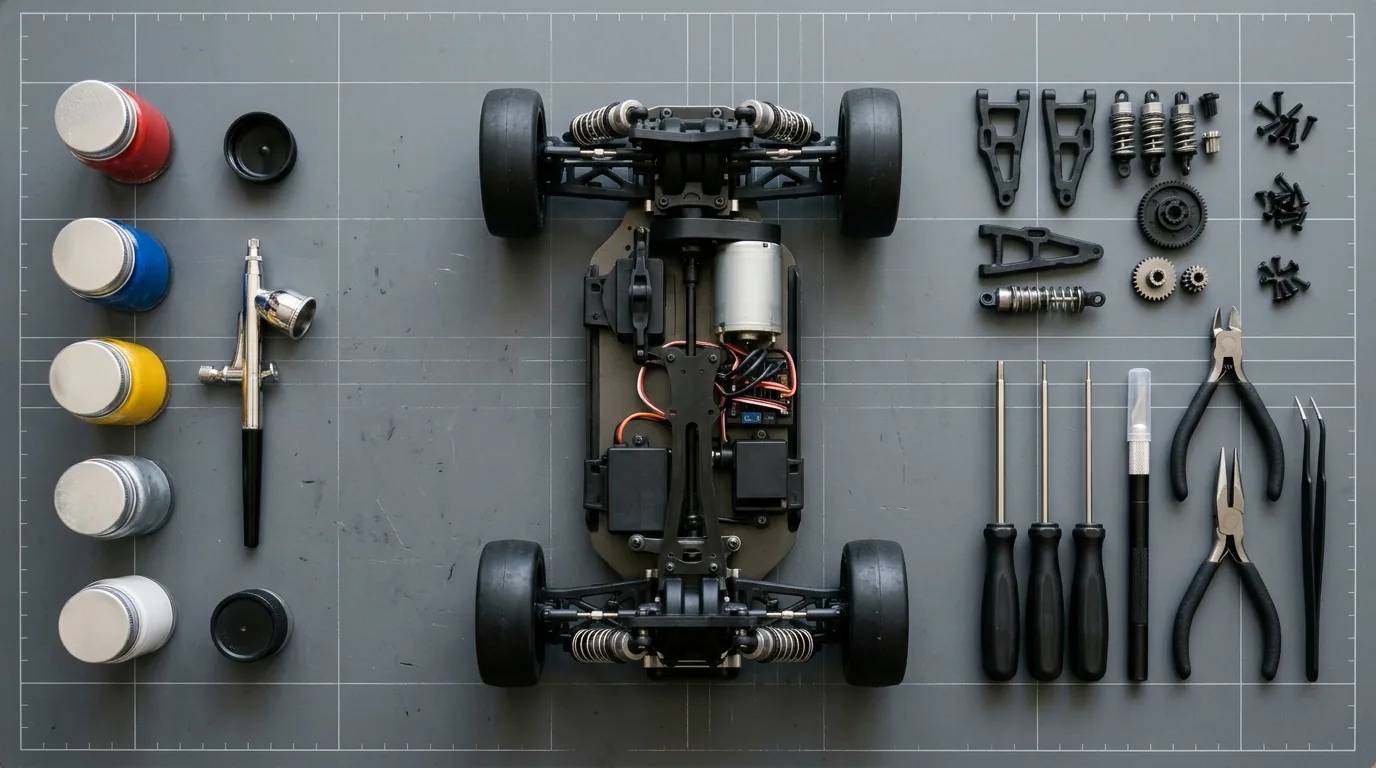
Tamiya's integrated finishing ecosystem is a third major differentiator, especially for scale-minded builders. Because the company operates a major Static Models business alongside its RC division, it supplies in-house Finishing Materials, Tamiya Craft Tools, Paints, and the Tamiya Airbrush System. Hobbyists who want clean polycarbonate paintwork, crisp trim, and realistic scale detail do not have to guess which tools and paints work together; they can draw directly from Tamiya's own finishing catalogue when preparing a bodyshell or display-worthy build.
Finally, Tamiya benefits from enduring community appeal that bridges generations of hobbyists. Independent RC media coverage of ambitious Tamiya build projects—such as the life-size Volkswagen Dune Beetle Cross feature highlighted on Big Squid RC—reflects a brand culture rooted in assembly, nostalgia, and custom craftsmanship rather than purely chasing headline speed numbers.
Tamiya RC Lineup and Platform Comparison
Choosing the right entry point into Tamiya's catalogue starts with matching its published vehicle categories to your preferred power system, driving venue, and level of scale detail. Within car platforms, Tamiya separates Electric R/C Cars and Glow-Engine R/C Cars as distinct pathways. Electric R/C Cars generally appeal to UK hobbyists seeking quieter, battery-powered convenience suited to local car parks, gardens, and club tracks, whereas Glow-Engine R/C Cars target enthusiasts who specifically want the mechanical involvement and sound of fuel-powered running.
Outside standard cars, Tamiya's specialist scale lines diverge sharply from its competition hardware. R/C Tractor Trucks and R/C Tanks prioritise mechanical realism, intricate assembly, and detailed finishing work—areas where Tamiya's Craft Tools, Paints, and Finishing Materials come into their own. By contrast, the TRF Series sits at the performance-oriented end of the catalogue for drivers focused on structured track running rather than display realism.
| Published Tamiya Category | Primary Focus | Typical Hobbyist Fit | Supporting Tamiya Categories |
|---|---|---|---|
| Electric R/C Cars | Battery-powered on-road and off-road cars | First-time builders, casual drivers, and club racers | R/C Parts, R/C Equipment, Paints, Craft Tools |
| Glow-Engine R/C Cars | Fuel-powered RC car platforms | Enthusiasts seeking internal-combustion operation | R/C Parts, R/C Equipment, Craft Tools |
| R/C Tractor Trucks | Specialist heavy-vehicle scale modelling | Scale builders prioritising detail and realism | R/C Parts, Finishing Materials, Paints, Airbrush System |
| R/C Tanks | Specialist tracked military RC models | Military modellers and detailed scale hobbyists | R/C Parts, Finishing Materials, Paints, Airbrush System |
| TRF Series | Competition-oriented RC car platforms | Track-focused drivers and experienced racers | R/C Parts, R/C Equipment, Craft Tools |
Viewing Tamiya's lineup alongside wider RC market news helps set realistic expectations. Independent editorial coverage on Big Squid RC regularly highlights purpose-built bashers and extreme speed machines from other manufacturers—such as Team Corally's 1/8 SYNCRO-4 RS RTR Buggy, marketed around 4S brushless power and heavy durability for racing and bashing, or Rlaarlo's 1/6 AK-962 speed-run car designed to run dual brushless motors with a target of triple-digit speeds. Tamiya's official catalogue does not position itself around that extreme-bashing niche; instead, it offers breadth, build engagement, and scale finishing across five distinct vehicle classes.
Limitations and Evidence Gaps to Consider
AI-generated generic editorial illustration — not a retailer product photo and does not depict the reviewed product or service. Editorial illustration supporting this section.
While Tamiya's official catalogue demonstrates impressive breadth, UK buyers should recognise several important limitations and information gaps before ordering. First, Tamiya's top-level RC overview does not publish chassis-level technical benchmarks such as brushless motor ratings, LiPo battery cell limits, or out-of-the-box impact durability data. Hobbyists comparing brushless powertrains or planning to run modern LiPo packs cannot rely on the global category index alone and must inspect individual model specifications carefully.
Second, buyers seeking heavy-duty, straight-from-the-box bashing should weigh Tamiya's build-and-scale orientation against dedicated basher platforms. Independent RC coverage illustrates how aggressively rival brands target turnkey durability and raw speed—from 4S brushless 1/8 RTR buggies like the Team Corally SYNCRO-4 RS to large dual-brushless speed-run platforms such as the Rlaarlo AK-962. If your primary goal is launching a ready-to-run buggy over rough UK park terrain with minimal bench time, a build-focused Tamiya kit may require extra setup, electronics planning, and careful driving expectations compared with purpose-built bashers.
Third, critical UK purchasing details are not verified on Tamiya's global English RC index. The top-level page does not list UK retail pricing, specify which electronics (such as radio transmitters, receivers, servos, speed controllers, batteries, or chargers) are included in a particular box, or show live spares availability at UK hobby shops. Similarly, while Tamiya lists official R/C Parts as a category, real-world parts turnaround in the UK depends on local distributor and retailer stockholding rather than the global catalogue alone. Checking those specifics with a reputable UK retailer before committing helps prevent unexpected completion costs or delays waiting on replacement components.
Practical Buying Checklist for UK Hobbyists
AI-generated generic editorial illustration — not a retailer product photo and does not depict the reviewed product or service. Editorial illustration supporting this section.
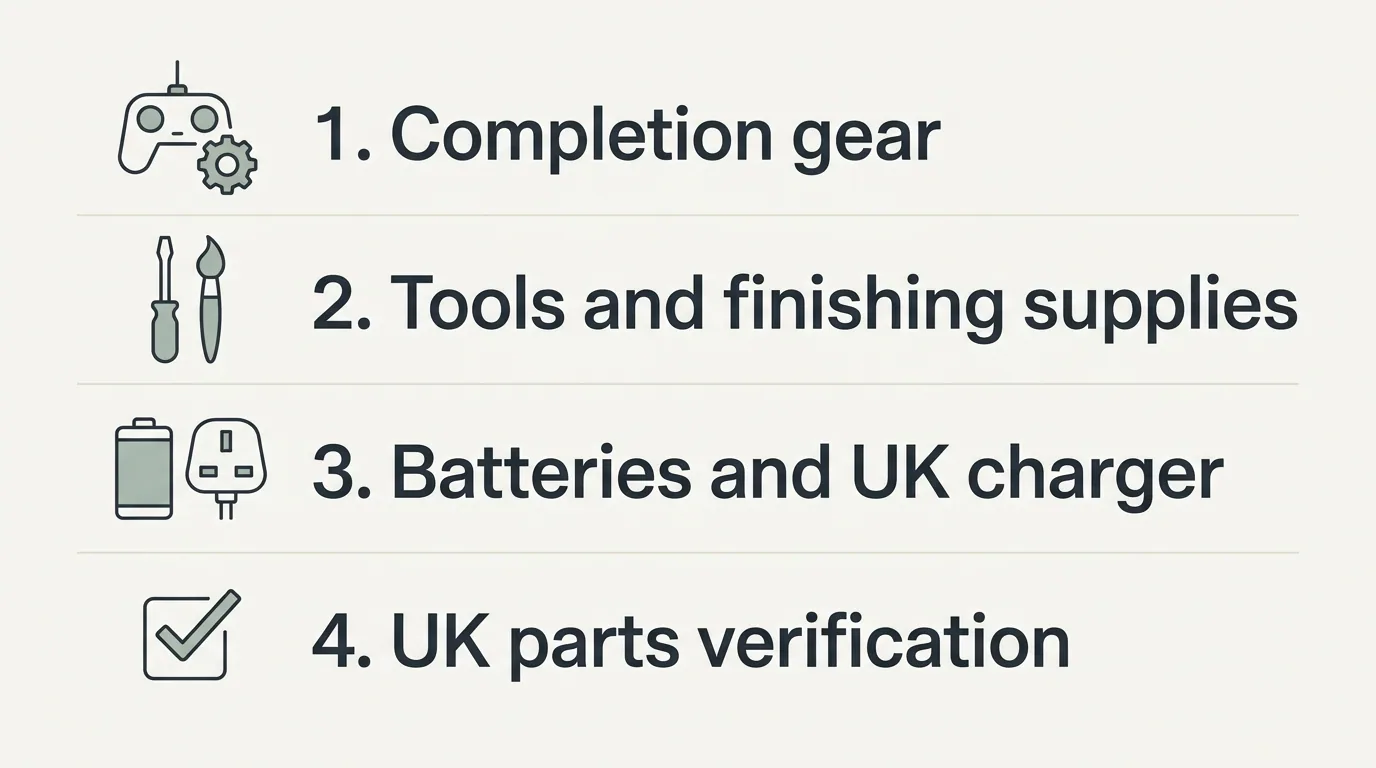
Because Tamiya's ecosystem separates vehicles, running gear, finishing supplies, and spare parts, a little upfront planning goes a long way. Before placing an order with a UK hobby retailer, work through these four practical checks:
- Budget for completion gear and R/C Equipment: Confirm exactly what is supplied in the box. Where a kit excludes radio gear, a steering servo, an electronic speed controller, or a motor, factor those R/C Equipment costs into your total spend from the outset rather than budgeting for the base vehicle price alone.
- Plan your tools and finishing supplies: If you are choosing a build-it-yourself kit or a scale-focused platform such as a tractor truck, tank, or unpainted car bodyshell, check whether you need Tamiya Craft Tools, Paints, Finishing Materials, or airbrush supplies. Having the right cutters, screwdrivers, and polycarbonate-compatible paints ready prevents delays midway through assembly.
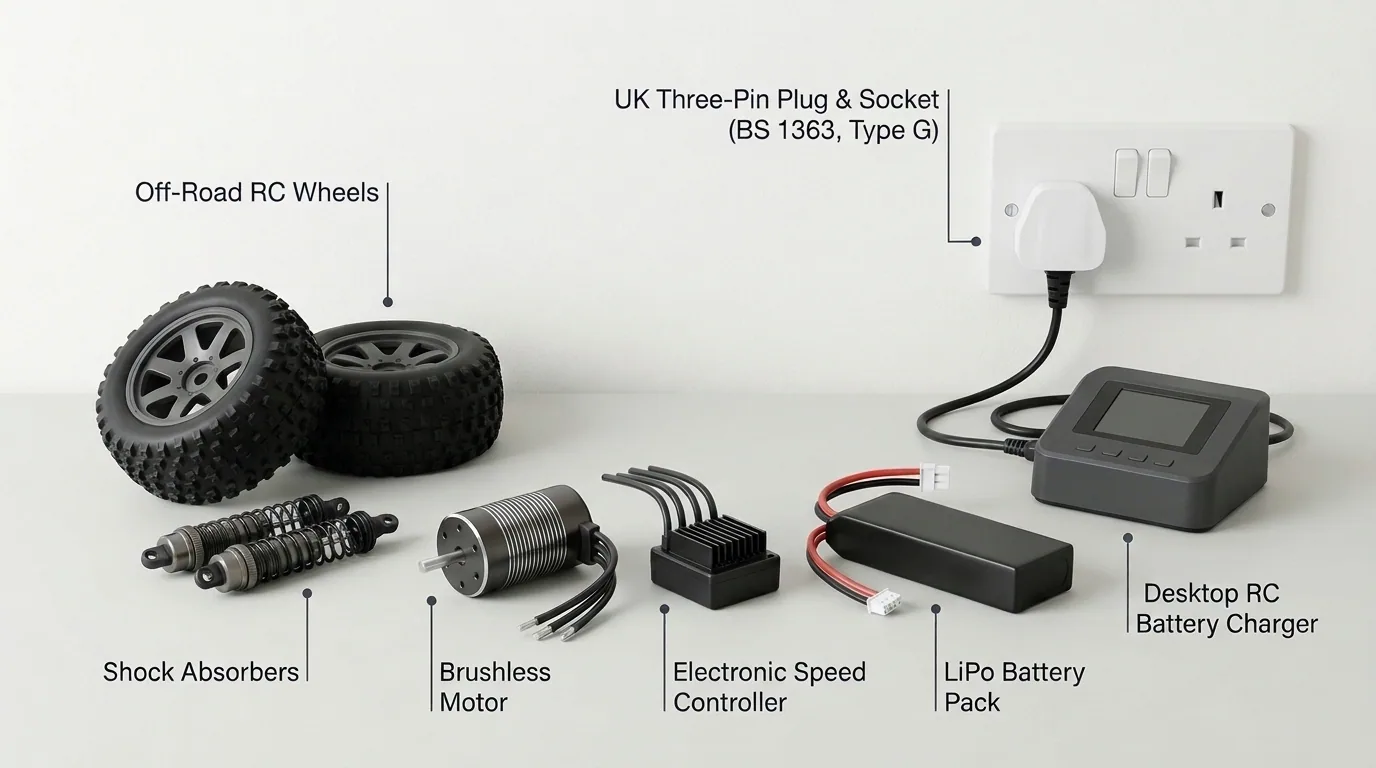
- Verify battery and UK charger compatibility: Check the specific chassis documentation for accepted battery dimensions, connector types, and chemistry limits before buying LiPo or NiMH packs. Pair your batteries with a suitable multi-chemistry charger fitted with a UK mains plug; the wider RC market offers everything from compact entry-level chargers to high-output multi-port AC/DC units such as four-port desktop chargers featured in RC hardware news.
- Confirm UK spares availability in advance: Identify the official Tamiya R/C Parts numbers for common wear items—such as suspension arms, gears, and hubs—and check that UK hobby shops hold them in stock before you commit to a platform.
In terms of buyer fit, Tamiya is a strong match for UK scale builders, kit enthusiasts, and club-oriented drivers who enjoy assembly, painting, and maintaining a model with first-party parts and finishing tools. Conversely, high-power park bashers who prioritise turnkey 4S brushless toughness and minimal bench time may find heavy-duty RTR alternatives a better fit for their driving style.
Frequently Asked Questions
What types of RC vehicles does Tamiya produce in its official lineup?
According to Tamiya's official R/C Models top page, the manufacturer organises its RC vehicles into five main categories: Electric R/C Cars, Glow-Engine R/C Cars, R/C Tractor Trucks, R/C Tanks, and the competition-focused TRF Series. This spans casual and club car driving, fuel-powered platforms, specialist heavy-scale models, and track-oriented builds under one brand.
Does Tamiya supply official spare parts, equipment, and painting tools for its RC models?
Yes. Tamiya lists dedicated R/C Parts and R/C Equipment categories directly within its R/C Models section to support maintenance, repairs, and running setups. In addition, its Tools & Paints range includes Finishing Materials, Tamiya Craft Tools, Paints, the Tamiya Airbrush System, and Display Goods, giving scale-minded RC builders access to first-party assembly and painting supplies.
How does Tamiya compare with brushless RTR basher brands for UK buyers?
Tamiya's official catalogue focuses on multi-category breadth, kit-building heritage, first-party parts support, and scale finishing tools. By contrast, basher-oriented RTR brands featured in independent RC media—such as Team Corally's 4S brushless 1/8 SYNCRO-4 RS RTR Buggy or Rlaarlo's dual-brushless 1/6 AK-962 speed-run car—emphasise turnkey high-voltage power and heavy-duty bashing out of the box. UK buyers should choose based on whether they value building and scale finishing or immediate high-power bashing.
What should UK buyers verify before ordering a Tamiya RC kit or platform?
Because Tamiya's global RC overview does not publish UK pricing, box-level electronics lists, chassis-specific brushless or LiPo limits, or local stock levels, UK buyers should verify four items with a UK retailer before ordering: total completion gear required, necessary tools and paints, battery and UK-plug charger compatibility, and local stock of official Tamiya R/C Parts for routine repairs.
Sources
Related reading
- FTX review: practical buying assessment
- How to choose RC Cars and Trucks for your needs
- How RC Cars and Trucks should fit, feel, and perform
- When to buy RC Cars and Trucks for better value
Editorial information: About our editorial team · Read our editorial policy · Read our affiliate disclosure.